
Custodians of Duration: On Collecting, Mortality, and the Desire to Persist
A software engineer whose work vanishes within months reflects on why he collects four-thousand-year-old Cypriot antiquities, and what the desire to attach oneself to durable objects reveals about confronting mortality at thirty.
Alexis Drakopoulos
November 27, 2025·Archeology · History·12 min read


Share


Alexis Drakopoulos is a Greek Cypriot Machine Learning Engineer working in Financial Crimes. He is passionate about Archeology and making it accessible to everyone. About Me.
I. The Problem of Impermanence
I write software for a living, and I am good at it. The work is intellectually demanding, often consuming months of concentrated effort to architect systems, build models, and solve problems that feel genuinely difficult. And then, if I am lucky, the thing I built will survive for a year or two before it is deprecated, replaced, or simply switched off. Sometimes it doesn't last a day.
This is not a complaint about the technology industry so much as an observation about a particular kind of making. There are people who build houses, paint canvases, write books, and these things can outlast their makers. Software engineers build elaborate structures out of logic and language, and those structures dissolve. The servers get decommissioned, the frameworks become obsolete, the code is rewritten from scratch by someone who never knew you existed.
I turned thirty recently, a minor milestone by most standards, but one that prompted reflection. I am technically still young and will likely live for decades more, but thirty is old enough to see the shape of a life, to understand that time is not infinite, and to begin asking what, if anything, will remain.
When I look at the world honestly, very little survives. Most human effort vanishes, and most people who have ever lived are completely forgotten, not even a name remaining. Within two or three generations of my death, I will be gone from living memory. My great-grandchildren, if I have any, will know almost nothing about me, and their children will know nothing at all. This is not morbid speculation. It is simply true.
II. A Different Relationship to Time
I have been visiting museums since I was a child. My father, a physicist with a deep love of archaeology, took me often: in the Alps near Grenoble, in Oxford surrounded by institutions like the Ashmolean, and later in Cyprus itself, where I spent summers and eventually settled as a teenager. I grew up looking at objects that were thousands of years old.
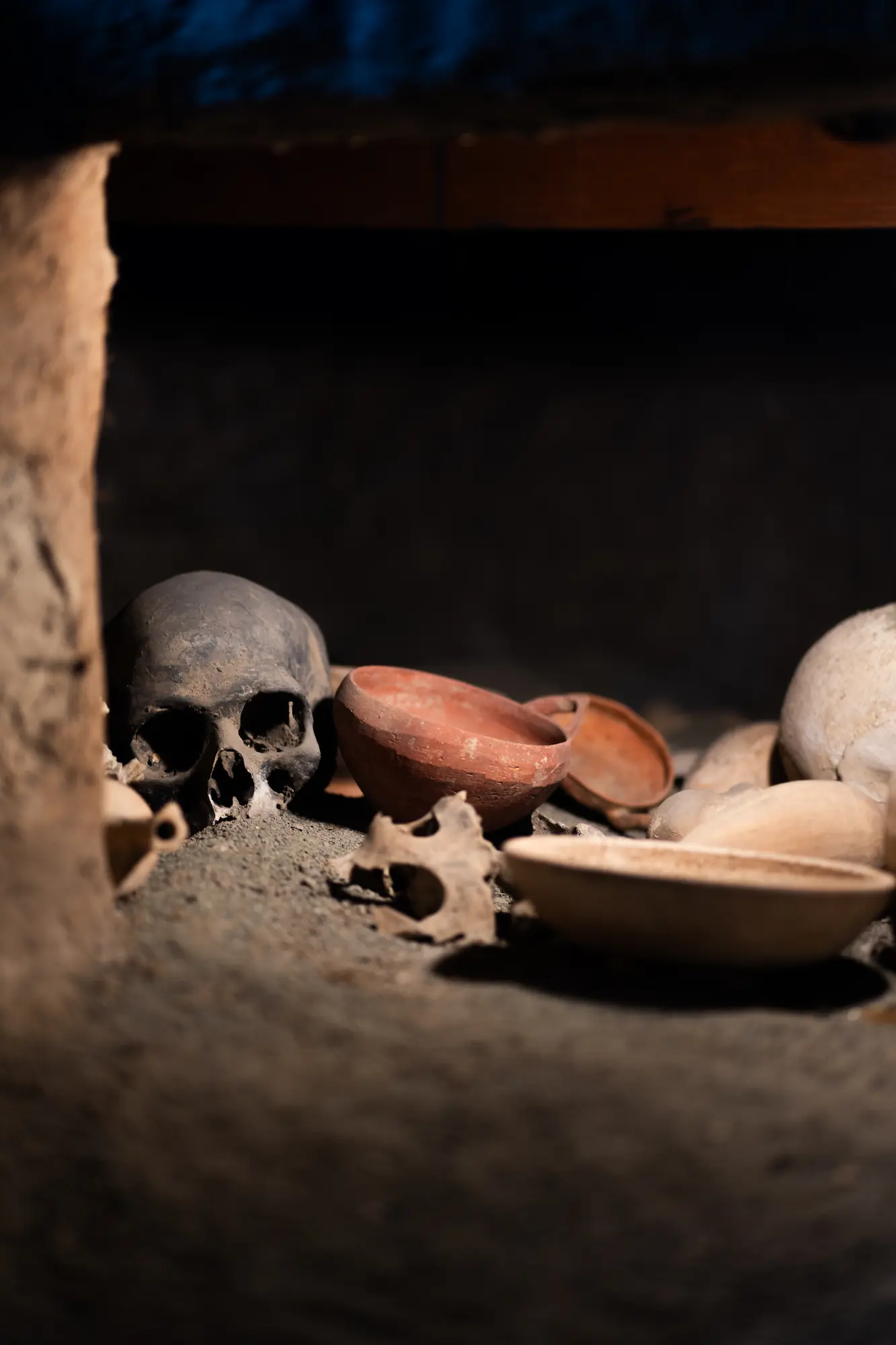
What struck me, even then, was that these objects had survived. Not the civilizations that made them, not the people who used them, but the objects themselves. A bowl shaped by hands four thousand years ago, a figurine placed in a tomb before the pyramids were built. These things had passed through more time than I could genuinely comprehend, and here they were, still existing, still available for someone to look at and wonder about.
In mid-2023, while researching for a website I had started about Cypriot archaeology, I encountered something that shifted my perspective. It was a small Early Bronze Age bowl from Cyprus, and unlike the thousands of artifacts I had studied in photographs or observed through glass, this one was for sale. The realization that private individuals could own such objects, could hold them, was startling to me.
I bought it. When it arrived, I experienced something I did not expect. Holding this object, feeling its weight and texture, knowing that it had been made by someone on my ancestral island four millennia ago, was qualitatively different from looking at similar objects in museums. There was a physical immediacy to it. I was not observing the past; I was, in some small way, touching it.
I began collecting, not compulsively or indiscriminately, but with purpose. Each piece I acquire is documented, photographed, and researched. I work with scholars and maintain communication with the Cypriot Department of Antiquities, and I have helped identify and repatriate objects stolen during the 1974 invasion. I am not interested in possession for its own sake.
But I would be lying if I said the impulse was purely about preservation or education. Part of it, and I think an important part to examine honestly, is about death.
III. The Two Lives of Objects
I often speak of antiquities as having two lives. The first life spans from the object's creation to its burial or loss: a bowl is made, used, perhaps cherished, and eventually ends up in the ground, whether placed deliberately in a tomb or abandoned when a settlement is destroyed. This first life can last years or centuries, but it ends with forgetting, and the object passes out of human awareness entirely.
The second life begins with rediscovery. An archaeologist excavates the bowl, or a farmer turns it up with a plow, or erosion exposes it on a hillside. The object re-enters human consciousness, where it is studied, catalogued, displayed, bought, sold, donated, written about. This second life is, in principle, indefinite. As long as humans exist and care about such things, the object can continue to be known.
What interests me philosophically is the nature of this second life. It is not merely that the object exists, since rocks also exist. The object persists as an object of attention, as something with a biography that humans actively maintain and extend. Each person who studies it, owns it, writes about it, or simply looks at it with genuine interest adds another small chapter to that biography.
When I acquire an antiquity, I become part of its second life. My name enters the provenance record. I research the piece, contribute what I learn, and make it available for others to study. In some small but real sense, I become woven into the history of this object.
And here is the thought I keep returning to: this object will, in all likelihood, outlast me by thousands of years. If it has already survived four millennia, there is no reason to think it will not survive four more. Long after I am dead, long after everyone who knew me is dead, this object will still exist. And somewhere in its documentation, there may be a note: Alexis Drakopoulos, collector, early twenty-first century.
IV. The Desire to Persist
I want to be careful here, because it would be easy to dress this up in noble language. Preservation of cultural heritage, democratizing access to history, education. These are real motivations, and I believe in them genuinely. But beneath them is something more personal and perhaps less admirable: I do not want to be completely forgotten.
The psychologist Ernest Becker argued that human beings, uniquely aware of their own mortality, are driven to pursue what he called immortality projects. These are symbolic strategies for transcending death, for achieving some form of continuity beyond the biological end. Some people seek this through children, others through creative work, others through religious faith in an afterlife. Becker thought this drive was fundamental to human psychology, shaping culture, ambition, and much of what we call meaning.
I recognize this drive in myself. The antiquities I collect are my immortality project, or one of them. Not because I believe I will literally live on, but because I want some trace of my existence to persist in the human record. I want to have mattered, even if only as a footnote.
This is worth examining critically. What exactly am I hoping for? The future scholar who sees my name in a provenance record will not know me. They will know a label, a name attached to a date range, with no sense of who I was, what I thought, what I loved or feared. Is that really persistence of me, or just persistence of a word?
I am not sure, but I think there is something to it nonetheless. Consider the alternative: complete erasure, no name, no trace, nothing to indicate that I existed at all. The prospect is vertiginous, and attaching myself to objects that endure feels like a handhold, however small, against that void.
V. Making Versus Associating
There is an interesting distinction between creating something durable and associating yourself with something already durable. The sculptor who carves a statue that lasts a thousand years has achieved a kind of immortality through making. The collector who acquires that statue a century after the sculptor's death achieves a different kind, through custodianship and documentation.
I am not a sculptor or a painter, and I have no particular talent for creating physical objects that last. My professional skills are oriented toward building things that dissolve. In this sense, collecting is a strategy available to me that creating is not. I cannot make something that will survive, but I can become the temporary guardian of something that already has.
There is humility in this, and perhaps also a kind of pragmatism. Rather than betting on my own capacity to create durability, I am betting on objects with a proven track record. A bowl that has survived four thousand years is a reasonable bet to survive four thousand more, while my software is not.
But there is also something that might be called borrowed persistence. I am not the source of the durability; I am attaching myself to it, hoping some of it transfers. Whether this is meaningfully different from the sculptor's achievement, I am not certain. The sculptor's name may be lost while the statue survives, and the collector's name may be preserved while the collector's actual personhood is equally gone.
Perhaps the difference matters less than I initially thought. Both the sculptor and the collector are seeking the same thing: some way of mattering beyond their biological span. The strategies differ, but the underlying motivation is the same.
VI. Objections and Tensions
I should address the obvious objection: this whole enterprise might be vanity dressed up as philosophy. The desire to be remembered is not obviously noble, and it could be mere ego, the refusal to accept one's proper insignificance in the face of cosmic time.
I accept this criticism partially. Yes, there is ego in it, and yes, I want to matter, and that wanting is not purely rational. But I am not sure ego is the right frame. The desire to persist seems to me deeply human rather than a character flaw to be overcome. Nearly everyone wants to be remembered by someone. The question is what we do with that desire.
There is also the ethical dimension of antiquities collecting, which I do not want to gloss over. The field has a dark history of looting, illicit trafficking, and the stripping of cultural heritage from source countries. Cyprus itself has suffered enormously from this, particularly after 1974. I have worked to position myself on the right side of these issues by acquiring objects with documented histories, collaborating with authorities, and assisting in repatriation efforts. But I am aware that the very market I participate in creates incentives for destruction.
This tension cannot be fully resolved. I can only say that I try to act ethically within a system that is imperfect, and that I believe careful, documented private collecting can serve preservation and scholarship rather than undermining them. Others may disagree, and I take their objections seriously.
VII. What Collecting Does and Does Not Resolve
I do not want to overstate what collecting accomplishes. It does not defeat death or guarantee memory. Many collectors are forgotten entirely, their names lost when records are misplaced or archives decay. Even if my name survives in some database, the me that exists now, the consciousness writing these words, will be gone regardless.
What collecting offers is not immortality but a different relationship to time. When I hold an object made four thousand years ago, I am participating in a continuity that extends far beyond my individual lifespan. Humans made this, humans preserved it, and humans will continue to study and care for it. I am one node in that chain, briefly holding the object before passing it on.
There is comfort in this, though not the comfort of permanence. It is more like the comfort of belonging to something that lasts, even if I do not last myself. The project of understanding and preserving the human past is larger than any individual, and by contributing to it, I become part of something that will continue.
Maybe this is enough. Maybe the search for personal persistence is, in the end, less important than participation in a collective endeavor that transcends any single life. I am not sure I fully believe this, and the desire to be remembered specifically, as an individual with a name and a history, remains. But perhaps that desire can coexist with a broader sense of meaning derived from contribution rather than recognition.
VIII. Living With Mortality
I am thirty years old and will likely live for several more decades. There is time to build things, contribute things, experience things. But the shape of the ending is visible now in a way it was not when I was twenty, and whatever I do, however I spend my time, it will conclude. The question is what posture to take toward that conclusion.
Collecting antiquities has not resolved my anxiety about mortality, but it has given me a way of engaging with it that feels meaningful. Each object I acquire is a small act of defiance against the forgetting that awaits us all. Not a successful defiance, since the forgetting will win in the end, but a gesture, a way of saying: I was here, I cared about this, I tried to preserve and understand something that mattered.
In a thousand years, someone may pick up a small Cypriot bowl and wonder about its history. If I have done my work well, they will know a little about where it came from, what it meant, and who held it along the way. My name might appear in that account, or it might not. Either way, the bowl will be there, carrying forward the accumulated attention of everyone who cared for it.
That seems, to me, like something worth doing. Not because it solves the problem of death, since nothing solves that, but because it is a way of taking death seriously without being paralyzed by it, a way of acting as if the future matters even though I will not be there to see it.
The objects endure. We, their temporary custodians, do what we can.