
Bernard Knapp and the Cyprus He Keeps Rewriting
Bernard Knapp pulled the prehistory of Cyprus out of pots-equal-peoples culture history and built the standard account of how controlling copper turned the island into a state. His most consistent move since has been to take that account apart, twice in print, in front of the field he leads.
Alexis Drakopoulos
April 2, 2026·Archeology · Research · History·11 min read


Share


Alexis Drakopoulos is a Greek Cypriot Machine Learning Engineer working in Financial Crimes. He is passionate about Archeology and making it accessible to everyone. About Me.
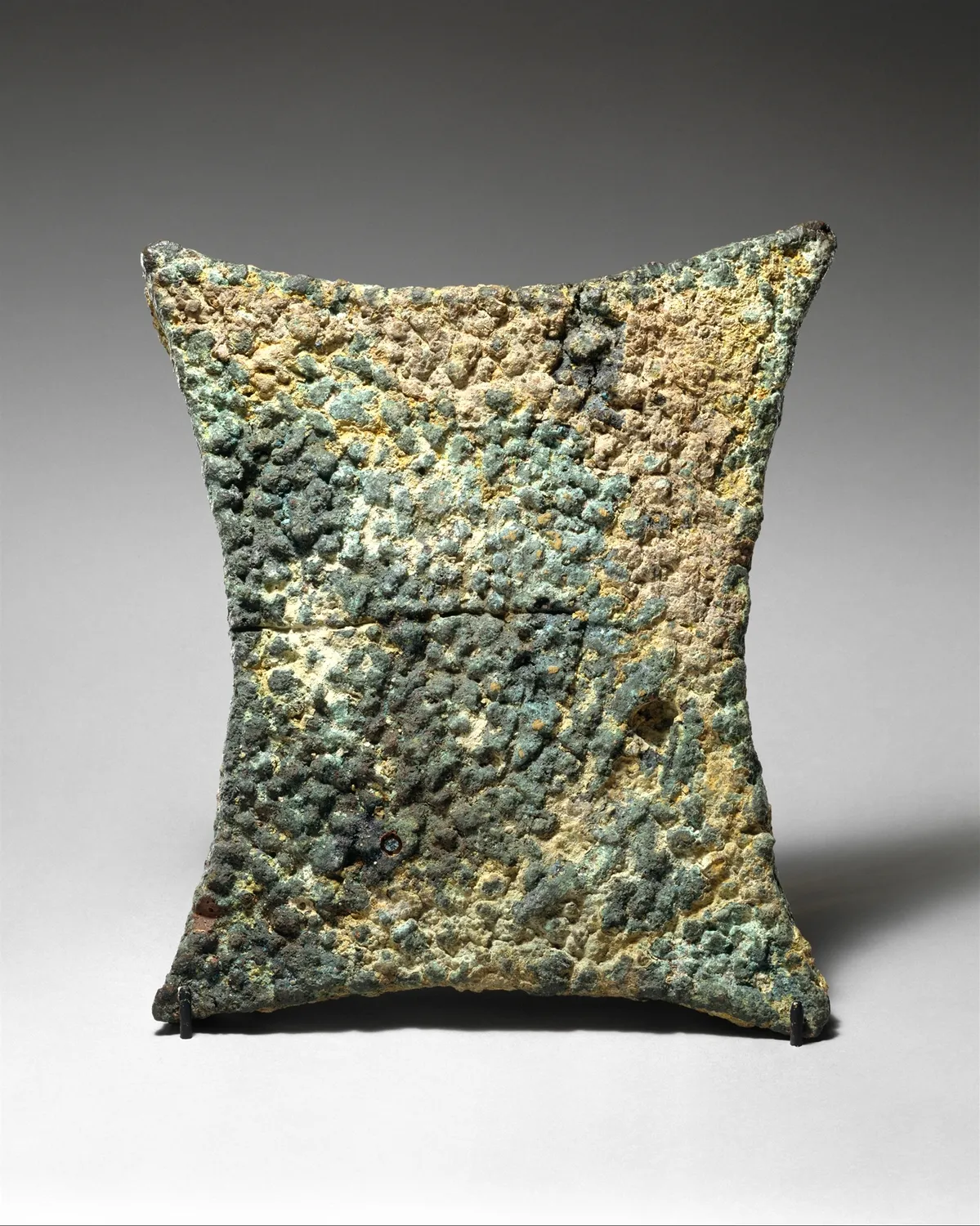
Around 1996 a survey Bernard Knapp was co-directing in the foothills of the Troodos picked up a scatter of slag and broken clay near the village of Politiko, eight hundred metres from a body of copper ore. He and Vasiliki Kassianidou spent three short seasons digging the spot, called Phorades. They found no walls. Whoever smelted there had laid river pebbles into flat terraces, lit furnaces in the open air, and gone when the season turned. What was left came to about three and a half tons of slag, more than six thousand fragments of broken furnace, and some six hundred pieces of tuyère, the clay nozzles that fed air to the fire. Reduce all of it back to metal and it yields perhaps three hundred kilograms of copper, the entire output of the site, which is the earliest primary copper-smelting workshop yet found on Cyprus. [1]
Knapp had spent his career arguing that copper made Cyprus a state. Demand for the metal abroad, he held, drove competition to control its production and exchange; that competition built wealth, then rank, then towns, then a polity. And here was the oldest copper works on the island: a seasonal, open-air operation with no architecture and a few hundred kilograms of metal to show for its whole existence. He published the small numbers plainly. It is the kind of thing he does. Knapp is the leading living synthesist of Bronze Age Cyprus and the author of its standard survey, and the most dependable feature of his forty years of work is that he keeps revising it, twice to the point of taking his own model apart in print.
From Akron to a Fulbright in Nicosia
Arthur Bernard Knapp, who publishes as A. Bernard Knapp, was born in 1941. His bachelor's degree came from the University of Akron in 1967, not, as is often repeated, from Cincinnati; the master's and the doctorate were from Berkeley, the PhD in 1979 in ancient history and Mediterranean archaeology. [2] Cyprus was in the dissertation already: a study of the island's material culture in the Middle and Late Bronze Age, set against the cuneiform and Egyptian texts that name a copper-exporting kingdom called Alashiya. Whether that kingdom was Cyprus is a question that would run through everything he wrote afterward.
He lectured at Berkeley, held a research fellowship at Sydney, and in 1988 took a Fulbright to the Cyprus American Archaeological Research Institute in Nicosia, which fixed the island as his ground. That same year he and John Cherry founded the Journal of Mediterranean Archaeology and set about editing it, a partnership that lasted some thirty years. An Australian fellowship at Macquarie paid for the Sydney Cyprus Survey Project, the regional survey that turned up the slag at Phorades; partway through it, around 1996, he moved to a chair at Glasgow and took the project with him. [3] He is emeritus there now, and has kept publishing into his eighties, with books in 2018, 2021, 2023 and 2024.
From pots to paradigms
When Knapp started out, the prehistory of Cyprus was still mostly written as culture history: pottery styles stood in for peoples, and a change in the pots meant the arrival of new ones. In 1990 he published a long article in Current Anthropology that read the same evidence as a record of economy and power instead. [2] The journal ran it with peer commentary, and the commentators caught the change of key. One called it a shift "from pots to paradigms"; another credited it with bringing Cypriot archaeology fully inside modern archaeological theory. A single voice dissented: Jan Bouzek dismissed the article as economic determinism in New Archaeology dress, and Knapp answered him sharply. The combativeness was there from the start and has not mellowed.
The account that paper built became the standard one. Cyprus held the eastern Mediterranean's most workable copper; as foreign demand for it rose, the people who could control the mining, smelting and export grew rich, and the distance between them and everyone else hardened into rank, into towns, into a polity. Knapp drew a careful line inside the system. "For the miners and producers," he wrote, "copper may have functioned as a commodity; for the consumers and distributors on the north coast, metals may have served as items of wealth and status." [2] The metal-rich tombs at Lapithos, on that north coast, marked in his reading the first pull of the demand from abroad.
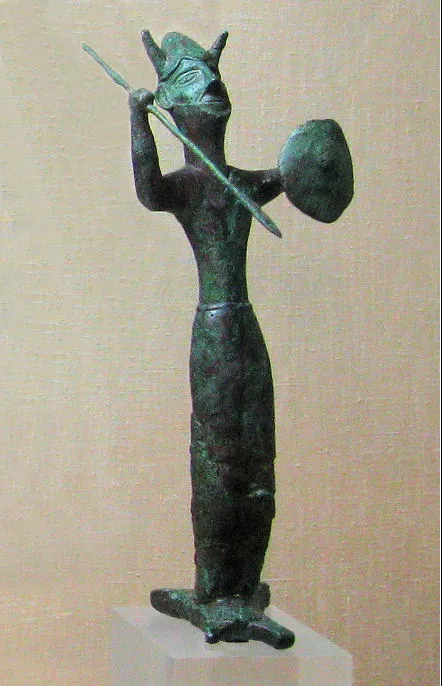
He had taken on the religion four years earlier. In a 1986 monograph, Copper Production and Divine Protection, Knapp looked at the bronze warrior from Enkomi who stands on a miniature oxhide ingot, the figure known as the Ingot God, and at the metal workshops built hard against the temples at Kition and Enkomi, and refused to read them as proof that priests controlled the copper industry. [4] The Ingot God and the ingot imagery were, he argued, "material icons" by which a secular elite secured and legitimised its hold on the metal. Where others had found sacred kingship, Knapp found power dressed as piety.
Was Cyprus the kingdom of Alashiya?
The kingdom from the dissertation came back, and Knapp never let it go. By his 2008 synthesis he held the identification of Cyprus with Alashiya to be "indisputable," and dared anyone still unconvinced to name another island or region that fit the texts as well. [5] He had already edited the corpus itself: the 1996 Sources for the History of Cyprus, Volume II, which gathers the roughly hundred and twenty cuneiform and Egyptian documents that mention Alashiya. [6] The king of Alashiya is the one correspondent in the Amarna archive who ships pharaoh copper and addresses him as "brother," the language of an equal. A 2003 study by Goren and colleagues traced the clay of the Alashiya letters found at Amarna and Ugarit to the southern foothills of the Troodos, about as near to a return address as the Bronze Age supplies. [5] Robert Merrillees, who spent a career on Cypriot chronology, has never accepted the equation. Knapp treats it as closed.
Migration, or mixing?
The idea of his that has travelled furthest, and drawn the most fire, is hybridisation. Material culture, Knapp argues, is chosen and reproduced; it is never a clean badge of ethnicity. "No single factor can be equated directly with ethnicity," he and Voskos wrote in 2008, "neither biology or physical difference nor technology nor material culture, not even culture and language." [7] When two populations meet, what comes out is a new and locally distinct culture, a mixing, which he set against the older language of "acculturation," "colonisation" and ethnic replacement.
He pressed the point at both ends of the Bronze Age. At the start of it, against David Frankel and Jennifer Webb's case for an incoming Anatolian population, he argued that the change was a hybridisation whose result stayed "solidly Cypriot in origin, outlook and makeup," and called the very framing of one culture "acculturating" another inherently colonialist. [5] At the close of it, against the long-told story that Mycenaean Greeks colonised Cyprus around 1200 BC, he and Voskos wrote that what happened on the island between about 1200 and 1000 "has little to do with an outright colonization." [7] He then set that story in its own time, noting that Greek-speaking Cypriots had embraced the idea of an ancient Aegean colonisation to support their demand for union with Greece against British rule. [7] His longest version of the argument, the 2021 Migration Myths and the End of the Bronze Age, dismantles the Sea Peoples and the Philistine invasion as explanations for the collapse around 1200; he concedes he is "swimming against an inexorable tide." [8]
The tide pushed back. Reinhard Jung, reviewing Knapp's 2013 survey, put the sharpest objection on the record. Hybridisation, he said, names an outcome, and an outcome is not an alternative to migration; Knapp had passed over the most ordinary and most telling evidence of all. Around 1200 the cooking pots of Cyprus change, fast, to wheel-made Aegean types. People do not lightly change the way they cook, and the switch is hard to account for without a real movement of people from the Aegean into Cypriot kitchens. [9] Webb, the named target of the "colonialist" charge, answered with more patience and declined it.
Revolution within evolution
For twenty-five years the complexity model had been gradual, with power gathering slowly as the copper economy swelled. In 2013, in a paper called "Revolution Within Evolution," Knapp dropped it. [10] The material signs of a stratified society, he now argued, do not turn up together on Cyprus until about 1700 BC, and when they do they arrive quickly; the island underwent the punctuated emergence of a centralised "secondary state," not a long ascent. The author of the gradual model had spent a paper dismantling it.
The centralised state is the ground he holds. Knapp is the maximalist in a long argument over how Bronze Age Cyprus was run: one hierarchical polity under a king, a šarru, by the fourteenth century at the latest. Edgar Peltenburg read the same evidence as a looser, devolved arrangement; Priscilla Keswani argued for heterarchy, several polities competing and cooperating rather than one set above the rest. Knapp named the deadlock himself: "Peltenburg takes a minimalist view, whilst my own position may be regarded as maximalist. Thus we arrive at an impasse." [10] His best card is logistics. Moving copper in bulk, the hundreds of ingots behind the Amarna letters, the ten tons that sank with the ship at Uluburun, needs the kind of mobilisation that argues for a centre. Phorades, with its three hundred kilograms, sat at the other end of that scale.
Then he complicated his own state. In 2023, with Nathan Meyer, Knapp argued that a new economic class, the merchant, was taking shape across the Late Bronze Age on Cyprus, and that the island was a likely birthplace for the Mediterranean's first merchant class. [11] Merchants leave a recognisable trace, weights and balance pans, cylinder seals, writing equipment, stored imports, and the trace is there. The difficulty, for his earlier model, is that merchants sit partly outside elite control: a market-driven, partly non-elite layer the ruling power could not simply direct. The 2024 book Cyprus and Ugarit followed the connection to the Syrian coast, where the one named Alashiyan king, Kušmešuša, writes to the king of Ugarit as "my son" and sends him thirty-three copper ingots, the bearing of the senior party. [12] Both the elite-conflict and the class-conflict frameworks fit the data, Knapp and Meyer concluded, which is a careful way of saying the picture he drew in 1990 had been too simple.
Why provenance is not optional for him
There is a logic under all this revising, and it lies in how Knapp works. His archaeology is contextual to the root: an object's value is the record of where it was found and what lay beside it. With Cherry he argued for sourcing excavated metal by lead-isotope and contextual analysis rather than by guesses about style [13], and he quotes with approval Hector Catling's rule that the discipline's main task is to identify imports, fix their place and date, and find where they came from. An object without that record cannot do the work his method asks of it. The corollary needs no separate sermon: the Journal of Mediterranean Archaeology, which he founded, holds a strict line against publishing unprovenanced antiquities, and in a 1998 chapter with Sophia Antoniadou he set down the looting of the Cypriot north after 1974, the Hadjiprodromou collection at Famagusta stripped to a handful of its two thousand objects, the churches emptied. [14] An object torn from its find-spot is, for the archaeology he practises, already dead; the ethics follow from the epistemics.
The book the field uses and disputes
Not everyone grants him the pottery. David Frankel, reviewing the 2013 survey, admired the book and Sturt Manning's radiocarbon appendix but charged Knapp with an "aversion to ceramics" and "an ax to grind" over the Anatolian migration, and found the arguments about gender forced. [15] Nicholas Blackwell, calling the same book "the go-to reference work," thought the new vocabulary, PreBA and ProBA for the two halves of the Bronze Age, cumbersome. [16] The survey is the standard one, and the field leans on it while disputing its terms, which is more or less the position Knapp occupies in full.
Phorades is still the oldest copper works on the island, and it still made almost nothing: a few hundred kilograms of metal from an open-air operation a household could have run for part of a year. The account of how Cypriot copper built a state is largely his. So is the long, patient task of marking up that account where it runs too clean. The newest correction is the merchant, weights and seals in hand, working partly beyond the reach of the centralised state Knapp had defended for decades.
References
- 1.Knapp, A. B., Kassianidou, V., & Donnelly, M. (2001). Copper Smelting in Late Bronze Age Cyprus: The Excavations at Politiko Phorades. Near Eastern Archaeology, 64(4), 204–210.
- 2.Knapp, A. B. (1990). Production, Location, and Integration in Bronze Age Cyprus. Current Anthropology, 31(2), 147–176 (published with peer commentary; the author's biographical note records b. 1941, B.A. University of Akron 1967, Ph.D. UC Berkeley 1979).
- 3.Given, M., & Knapp, A. B. (2003). The Sydney Cyprus Survey Project: Social Approaches to Regional Archaeological Survey (Monumenta Archaeologica 21). Los Angeles: Cotsen Institute of Archaeology, UCLA.
- 4.Knapp, A. B. (1986). Copper Production and Divine Protection: Archaeology, Ideology and Social Complexity on Bronze Age Cyprus (Studies in Mediterranean Archaeology, Pocket-book 42). Göteborg: Paul Åströms Förlag.
- 5.Knapp, A. B. (2008). Prehistoric and Protohistoric Cyprus: Identity, Insularity and Connectivity. Oxford: Oxford University Press (on Alashiya as 'indisputable,' and embracing Goren et al. 2003 on the southern-Troodos sourcing of the Alashiya tablets).
- 6.Knapp, A. B. (ed.) (1996). Sources for the History of Cyprus, Vol. II: Near Eastern and Aegean Texts from the Third to the First Millennia BC. Altamont, NY: Greece and Cyprus Research Center.
- 7.Voskos, I., & Knapp, A. B. (2008). Cyprus at the End of the Late Bronze Age: Crisis and Colonization or Continuity and Hybridization? American Journal of Archaeology, 112(4), 659–684.
- 8.Knapp, A. B. (2021). Migration Myths and the End of the Bronze Age in the Eastern Mediterranean (Elements in the Archaeology of Europe). Cambridge: Cambridge University Press.
- 9.Jung, R. (2015). Review of A. B. Knapp, The Archaeology of Cyprus: From Earliest Prehistory through the Bronze Age. European Journal of Archaeology, 18(2).
- 10.Knapp, A. B. (2013). Revolution Within Evolution: The Emergence of a 'Secondary State' on Protohistoric Bronze Age Cyprus. Levant, 45(1), 25–47 (the 'impasse' with Peltenburg at p. 44).
- 11.Knapp, A. B., & Meyer, N. (2023). Merchants and Mercantile Society on Late Bronze Age Cyprus. American Journal of Archaeology, 127(3), 309–338.
- 12.Knapp, A. B. (2024). Cyprus and Ugarit: Connecting Material and Mercantile Worlds. Leiden: Sidestone Press.
- 13.Knapp, A. B., & Cherry, J. F. (1994). Provenience Studies and Bronze Age Cyprus: Production, Exchange and Politico-Economic Change (Monographs in World Archaeology 21). Madison, WI: Prehistory Press.
- 14.Knapp, A. B., & Antoniadou, S. (1998). Archaeology, Politics and the Cultural Heritage of Cyprus. In L. Meskell (ed.), Archaeology Under Fire: Nationalism, Politics and Heritage in the Eastern Mediterranean and Middle East (pp. 13–42). London: Routledge.
- 15.Frankel, D. (2014). Review of A. B. Knapp, The Archaeology of Cyprus. Bulletin of the American Schools of Oriental Research, 371, 203–205.
- 16.Blackwell, N. (2015). Review of A. B. Knapp, The Archaeology of Cyprus. Journal of Near Eastern Studies, 74(1).