
Anja Ulbrich and Cyprus's Silent Sanctuaries
Anja Ulbrich, a German classical archaeologist, became keeper of one of the largest collections of Cypriot antiquities outside the island and wrote the standard book on its ancient sanctuaries. Her career has turned on one idea: that you can tell a god's shrine from a goddess's by counting the figures the worshippers left behind.
Alexis Drakopoulos
January 23, 2026·Archeology · Research · History·10 min read


Share


Alexis Drakopoulos is a Greek Cypriot Machine Learning Engineer working in Financial Crimes. He is passionate about Archeology and making it accessible to everyone. About Me.
Anja Ulbrich has spent her working life among the gods of a small island whose names are mostly lost. A classical archaeologist trained in Germany, she has been the A. G. Leventis Curator of Cypriot Antiquities at the Ashmolean Museum in Oxford since 2009, keeper of one of the largest Cypriot collections held anywhere outside Cyprus, and the author of the standard book on the island's ancient sanctuaries. Her reputation rests on one stubbornly simple idea: that the worshippers who once crowded a Cypriot shrine left behind, in clay and limestone, a record of the god they had come to face.
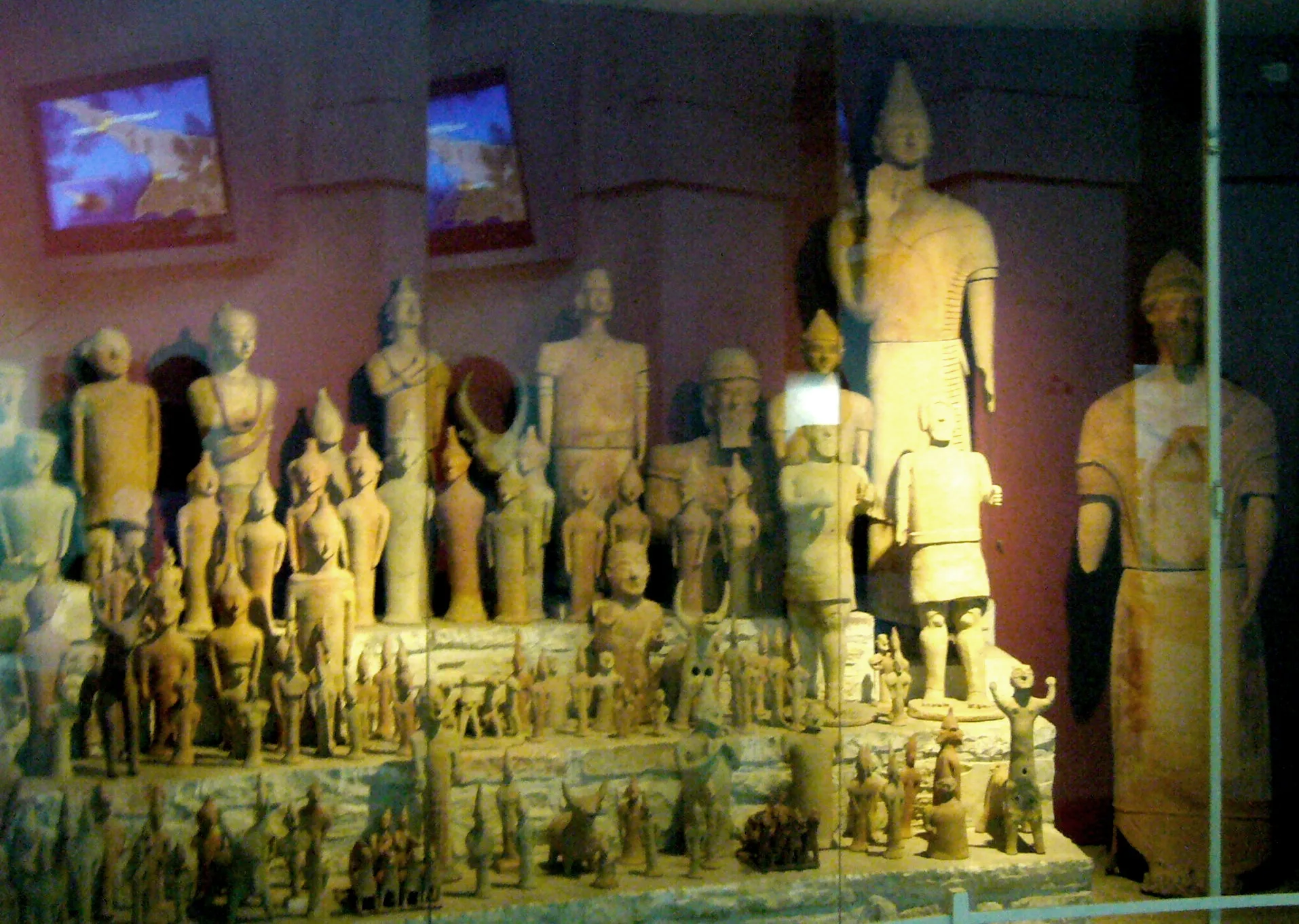
The problem she set herself shows clearly in a single field on the north coast. In the autumn of 1929 a Swedish team digging near Ayia Irini uncovered about two thousand terracotta figures standing where worshippers had left them: concentric semicircles packed around a low limestone altar, the small ones at the front, the life-sized at the back. The sanctuary carried no inscription, and it still carries none. The name of the god worshipped there is unknown [1].
The figures are the only record, and almost every one of them is male: bearded men in conical helmets, charioteers, warriors, a few priests holding offerings. On that evidence, and little else, the deity was judged a god [1]. The reasoning is plain to the point of looking like a trick. A Cypriot god drew male worshippers and a Cypriot goddess drew female ones, so the assembled figures report whose sanctuary it was even after the building has gone quiet.
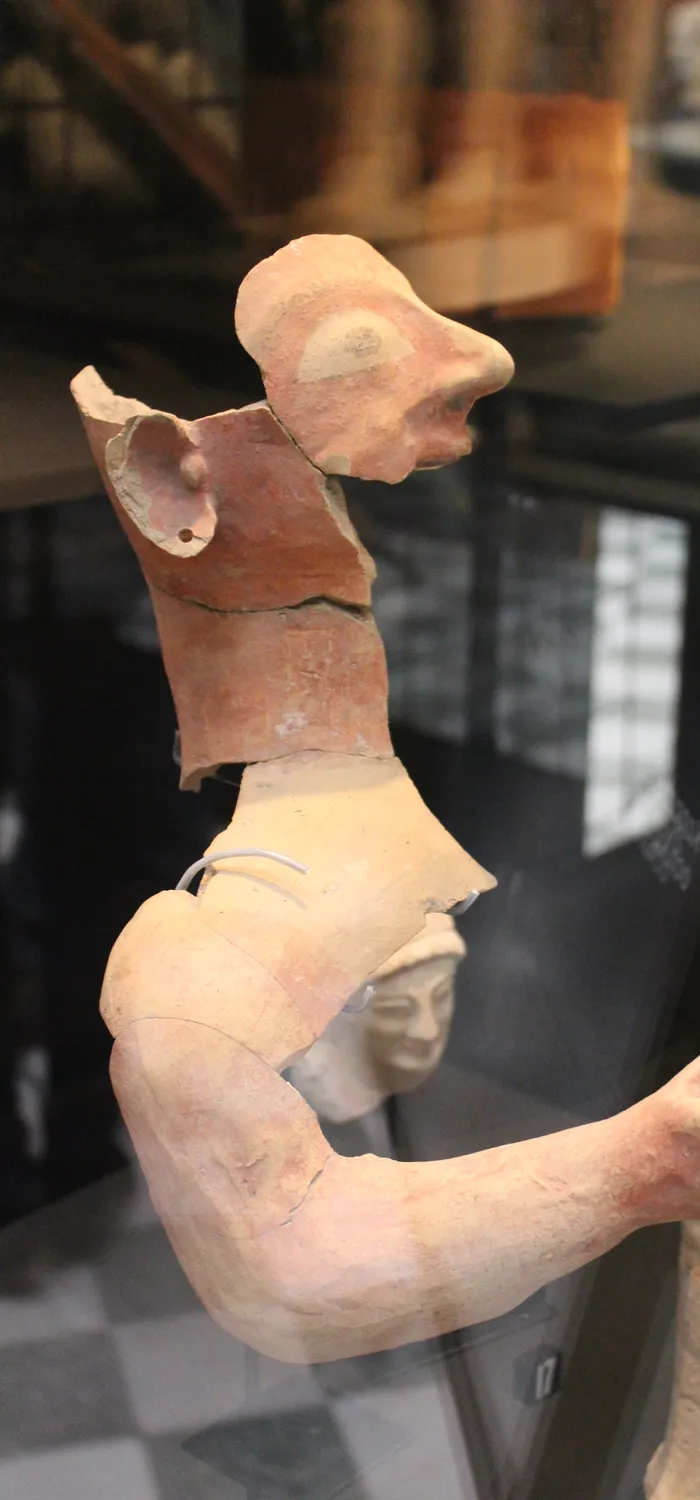
The pattern was already old when Ayia Irini came out of the ground. Max Ohnefalsch-Richter, the German excavator who worked across the island in the 1880s and 1890s, had noted in his Kypros, the Bible and Homer (1893) that sanctuaries of female deities filled with female figures and those of male deities with male ones, a regularity he traced across some seventy-two sites [2]. He offered it as an observation. Ulbrich made it a method. In her 2008 book Kypris she counted the figures sanctuary by sanctuary and used the ratio of the sexes to assign a god, a goddess, or a divine couple to cult-places no inscription would ever name. About two hundred such sites are known for the age of the Cypriot city-kingdoms; only around thirty can be tied to a named divinity by a dedication. The count is what brings the other hundred and seventy into a single religious map of the island [3][4].
From Heidelberg to Cyprus
Ulbrich came to Cyprus by way of Greece, and to Greece by way of the German university system. She read Classical Archaeology, Ancient History and the History of European Art at Heidelberg, a training rooted in the Greek and the European. Cyprus arrived later, and from the side. On an MPhil in Greek archaeology at Cambridge she met Cypriot material for the first time, and by her own account it held her. She went back to Heidelberg for a doctorate, defended in 2003, on the sanctuaries of female deities in Cyprus in the Archaic and Classical periods: the subject she would carry, with little deviation, for the next twenty years.
A research fellowship from the German Research Foundation took her next to Maroni-Vournes, an Archaic-to-Hellenistic sanctuary on the south coast that a University of Cincinnati team under Gerald Cadogan had dug in the 1980s and left largely unpublished. Her task was to bring its finds and architecture to print. The interim studies came out through the 2010s; the full sanctuary monograph, written with Cadogan for the British School at Athens, has been long in coming, and as of 2026 has still not appeared. That fellowship was the bridge. In 2009 the sanctuary specialist became curator of a collection full of sanctuary finds, and she has held the Leventis post since. She is also an associate member of the Faculty of Classics at Oxford, where she teaches Greek archaeology and supervises theses on Greek, Aegean and Cypriot subjects.
The hundred and seventy nameless sites
Kypris, published in 2008 as the book of the thesis, runs past five hundred pages and treats roughly two hundred cult-sites across the period of the city-kingdoms, from about 750 (she sets the floor nearer 720) to about 310 BCE [3]. It is built from everything available: excavation reports, inscriptions, coins, sculpture, and the ancient authors. Antoine Hermary, reviewing it, called it a véritable somme, a genuine summa, henceforth indispensable to any study of Cypriot religion in the age of the kingdoms [4]. Half the book is a catalogue, kingdom by kingdom from Amathous to Tamassos; the other half is the argument.
The argument rests on the count. Votary figures, the small images of the worshippers who left them, make up more than nine in ten of the human figures dedicated at a typical Cypriot sanctuary. So the question of whose sanctuary it was becomes a problem of sorting: mostly women, and the deity was a goddess; mostly men, a god; a real mix, perhaps a divine couple. Since roughly 85% of the island's known cult-sites carry no inscription naming a god, this is frequently the only evidence there is [3][6]. It is a portable, falsifiable argument: had the dedications come out evenly mixed across the island, there would be nothing to sort, and the method would collapse.
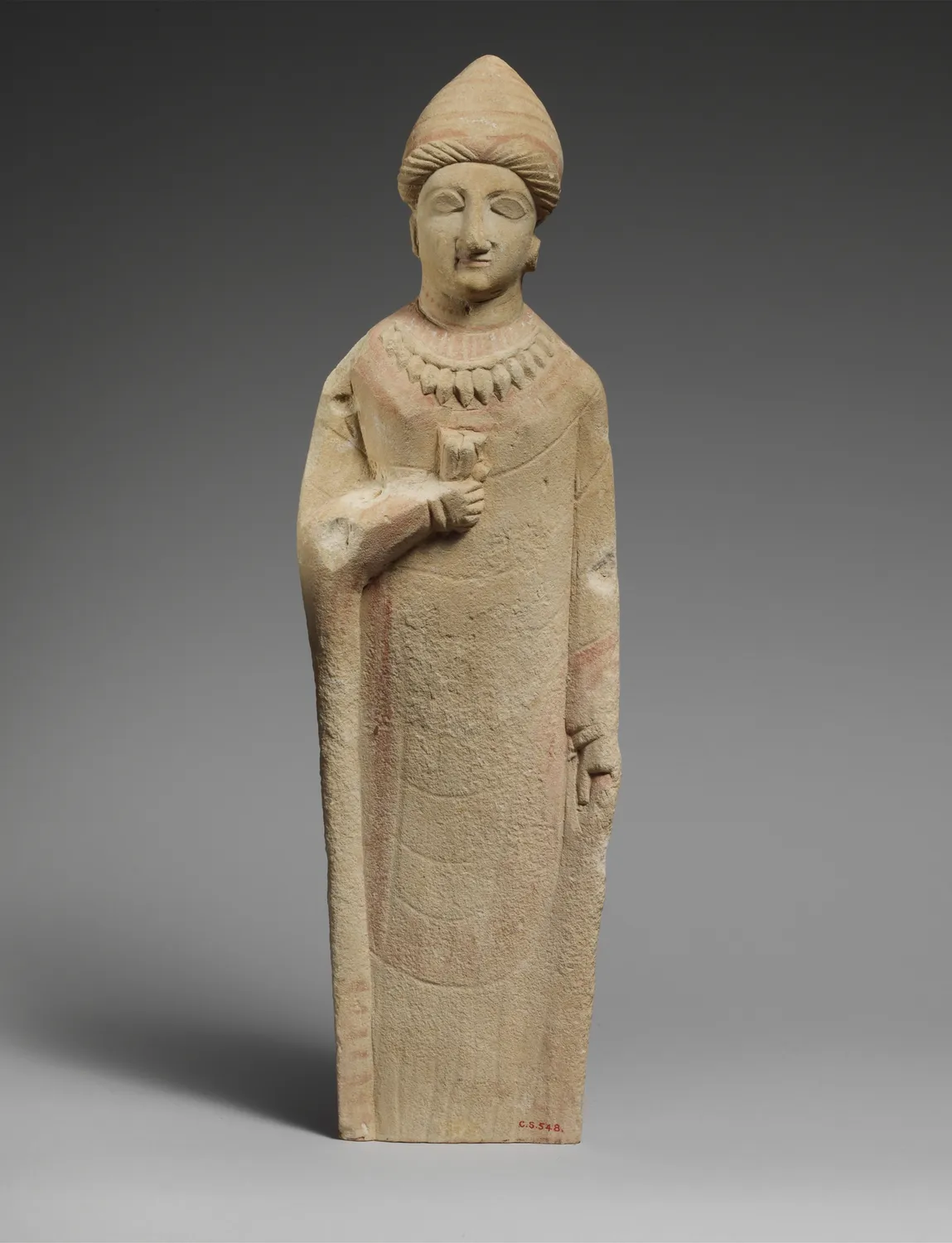
Then comes the bolder move. Behind the local names of Cyprus's goddesses, Paphia at Paphos, Golgia at Golgoi, the wanassa or "queen," the despoina or "mistress," Ulbrich saw one dominant goddess: the Kypris whom the Greeks identified with their Aphrodite. The goddesses with familiar Greek names, Artemis, Athena, Demeter, she read as Personifikationen, separate faces of that single goddess, formed by fitting Classical Greek statue-types onto a Cypriot base. The Cypriot specifics keep their place in this account: the Hathoric stelai with their Egyptian-derived faces, the women in the kalathos, the basket-shaped headdress worked with vegetal ornament. Sacred topography she read through categories built for the Greek and Etruscan worlds by François de Polignac and Ingrid Edlund, urban, peri-urban, extra-urban and frontier sanctuaries, adjusted to the conditions of the Cypriot royal towns, with palace cults included, as at Vouni and Amathous [3].
One goddess, or many?
The reviews were admiring and exact, which is the most useful kind. Hermary praised the catalogue's dossiers as extremely well documented, a mine of information on the kingdoms; he valued the use of the coin evidence and the handling of the female iconographic types [4]. He also said what was wrong. The book is very dense, and repeats itself, its end-of-chapter summaries doubling back over ground already covered, so that the link between the synthetic chapters and the catalogue is not always easy to follow. The dataset has ragged edges: Ulbrich admits a doubtful "Baal of Lebanon" at Mouti Shinoas while leaving out Malloura, a major sanctuary whose French and American excavations had already shown its importance. The chronological frame sits awkwardly too, because so much of the literary and epigraphic evidence she leans on is Ptolemaic or Imperial, centuries past her 310 BCE cut-off, by which time the cult had surely moved on [4]. The book had also gone to press just too early to take in Sabine Fourrier's 2007 study of Archaic Cypriot coroplasty, which bears directly on the number and territories of the very kingdoms her catalogue is arranged around [4][7].
These are the complaints of a reviewer who thinks the book indispensable. The deeper reservation came from Vinciane Pirenne-Delforge, a historian of Greek religion. She endorsed the engine of the book, that the gender of the dedications reveals the gender-profile of the deity, and welcomed the inclusion of male deities alongside the goddesses. Then she declined the conclusion [5]. The reduction of a whole pantheon to facets of one goddess, she observed, is a choice the interpreter makes, and the same evidence would support other readings. An anthropologist, or a historian of religions, might look at the same sanctuaries and find many goddesses where Ulbrich finds one under many names. The work, she wrote, went to the limits of what archaeological interpretation can bear.
That is the live wire in Ulbrich's scholarship. The count is near-unarguable: the figures can be sexed, the ratios are real, the silent sanctuaries can be sorted. The addition is the claim: that the goddess of Paphos and the goddess of Golgoi were the same goddess. The first is method; the second is a reading, and a reading is the thing other scholars are entitled to refuse.
Seven thousand objects
The Ashmolean's Cypriot collection runs to some seven thousand objects, most of it from recorded excavations, each piece with a find-spot behind it, which is what makes it worth the labour Ulbrich has put into it. As Leventis Curator she has driven a project to publish the entire collection online, each object tied where possible to the dig it came from [10]. She has also been the curatorial voice behind the museum's rebuilt Cyprus gallery and its new Greek World gallery, the scholarship turned into something a visitor can walk through. Since 2012 the Greek and Aegean collections have been her responsibility as well.
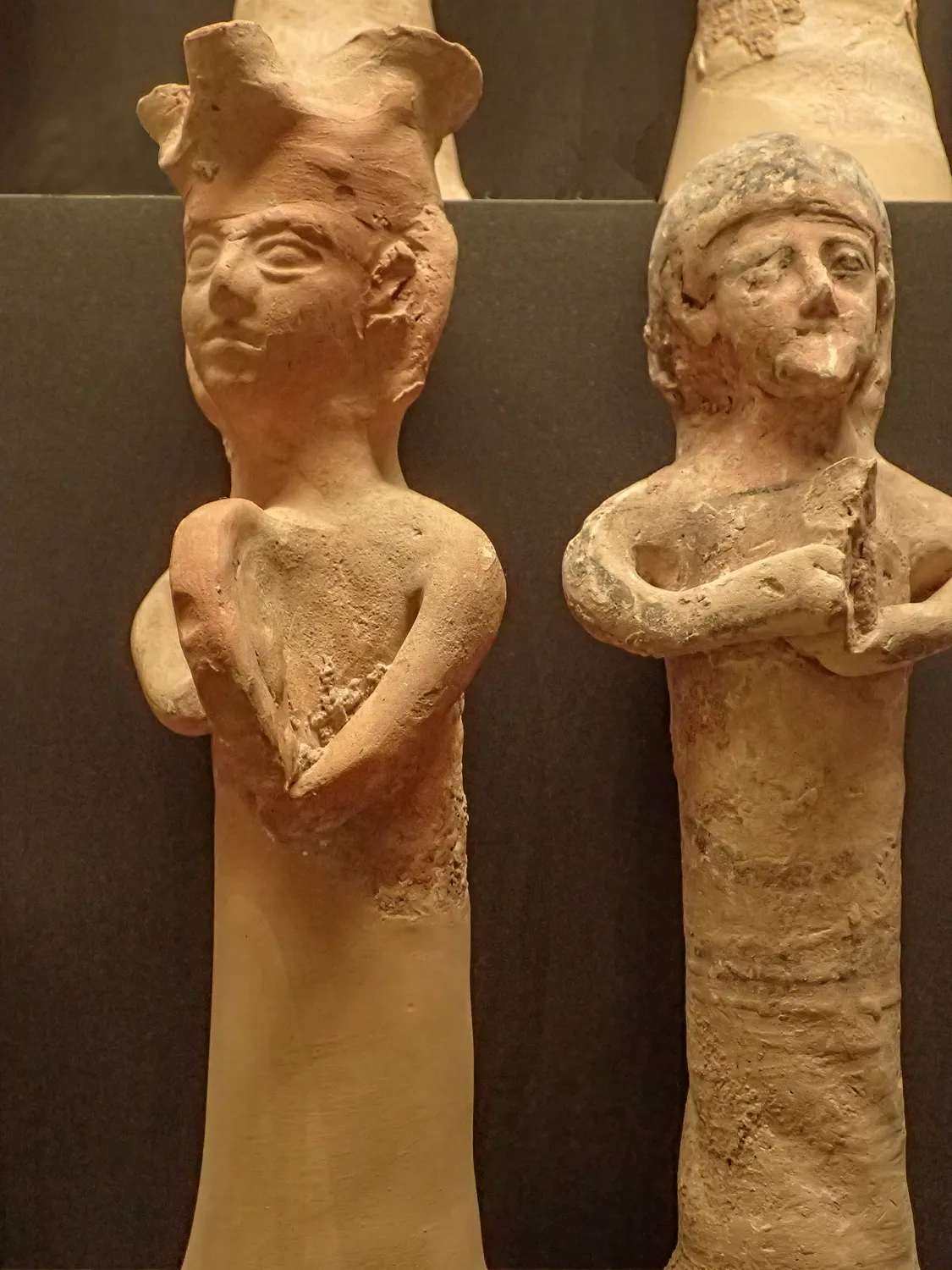
The excavated character of the collection matters to the argument as much as to the museum. Ulbrich's method only works on assemblages that were recorded as they came up, figure by figure, sex by sex. A sanctuary's worth of votaries scattered through the trade, stripped of their find-spots, cannot be counted the way Ayia Irini's could. The catalogue and the database are the same project as Kypris carried on by other means: keeping the evidence in a state where it can still be asked questions.
The women the histories left out
A third strand runs alongside the curator and the cult-historian: Ulbrich as a historian of her own discipline. She has written on how nineteenth-century excavation shaped, and distorted, the modern picture of Cypriot religion, the very record Ohnefalsch-Richter helped to make and to muddle [9]. With Thomas Kiely of the British Museum she has traced British involvement in the archaeology of Cyprus across the long nineteenth century and beyond, arguing that British influence ran through administration, money and private patronage, never through any scientific monopoly [8].
One thread of that work recovers people the standard histories had dropped, in particular the women who did the labour and lost the credit: Joan du Plat Taylor, Eleanor Stewart, and others who dug, catalogued and published without their names surviving in the usual citations [8]. Ulbrich writes that history as a woman who now runs one of the largest Cypriot collections outside the island and wrote the standard book on its sanctuaries.
A limestone woman in the kalathos, the kind dedicated by the hundred at Golgoi, gives the method its clean case: she is a worshipper, the deity she faced was a goddess, the sanctuary was the goddess's. What she cannot report is whether the goddess at Golgoi and the goddess at Paphos were one or two. Ulbrich counted the figures, then answered the question the figures cannot answer. Her reviewers, admiring the count, have left the answer where she put it, and open.
References
- 1.Pilides, D., & Papadimitriou, N. (eds.) (2012). Ancient Cyprus: Cultures in Dialogue. Nicosia: Department of Antiquities, Cyprus (Ayia Irini terracottas, cat. no. 268). The sanctuary was excavated by the Swedish Cyprus Expedition: Gjerstad, E., et al. (1935). The Swedish Cyprus Expedition, Vol. II. Stockholm.
- 2.Ohnefalsch-Richter, M. (1893). Kypros, the Bible and Homer: Oriental Civilization, Art and Religion in Ancient Times. London: Asher & Co.
- 3.Ulbrich, A. (2008). Kypris. Heiligtümer und Kulte weiblicher Gottheiten auf Zypern in der kyproarchaischen und kyproklassischen Epoche (Königszeit) (Alter Orient und Altes Testament 44). Münster: Ugarit-Verlag.
- 4.Hermary, A. (2009). Review of A. Ulbrich, Kypris. Cahiers du Centre d'Études Chypriotes, 39.
- 5.Pirenne-Delforge, V. (2010). Review of A. Ulbrich, Kypris. Kernos, 23 (online).
- 6.Ulbrich, A. (2011). Unpublished sculpture from ancient Idalion. Cahiers du Centre d'Études Chypriotes, 41.
- 7.Fourrier, S. (2007). La coroplastie chypriote archaïque: identités culturelles et politiques à l'époque des royaumes (Travaux de la Maison de l'Orient et de la Méditerranée 46). Lyon.
- 8.Kiely, T., & Ulbrich, A. (2012). Britain and the Archaeology of Cyprus. I. The long 19th century. Cahiers du Centre d'Études Chypriotes, 42. With the companion T. Kiely, 'Britain and the archaeology of Cyprus, Part II', extending the survey from 1914 to the present.
- 9.Ulbrich, A. (2001). An archaeology of cult? Cypriot sanctuaries in 19th-century archaeology. In V. Tatton-Brown (ed.), Cyprus in the 19th Century AD: Fact, Fancy and Fiction (Papers of the 22nd British Museum Classical Colloquium, 1998). Oxford: Oxbow, 93–106.
- 10.Ulbrich, A. (2012). The Cypriot collection at the Ashmolean Museum: a current digitisation project. Ashmolean Magazine, 64.